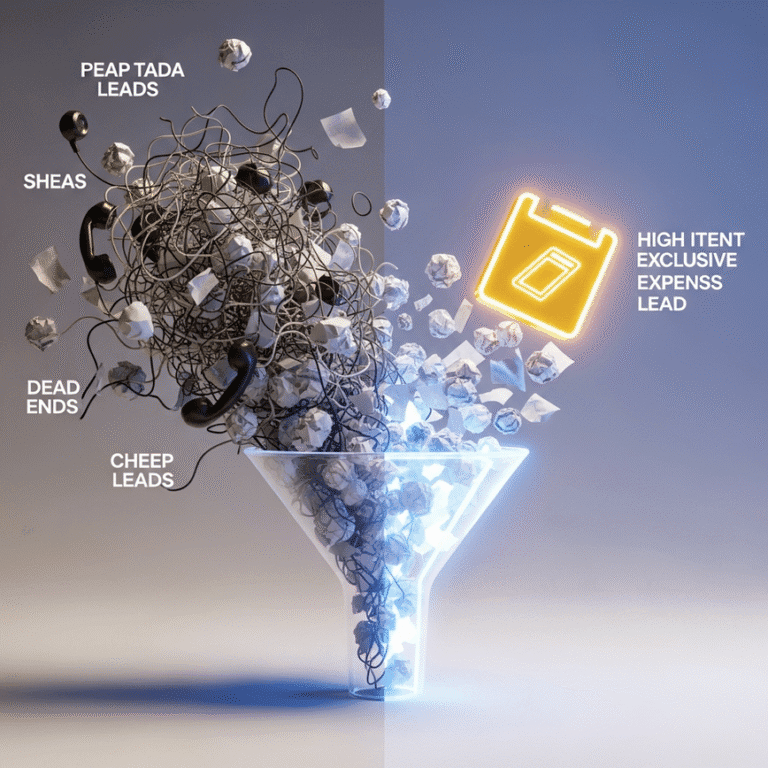
Every independent insurance agent and agency owner eventually asks the same question. They look at their CRM, review their bank account, and wonder if the numbers they are seeing are normal. Is a five percent closing ratio a cause for celebration or a sign of failure? Understanding the average lead conversion rate insurance agents should expect is not just about vanity metrics; it is about survival.
Table of Contents
- The Mathematics of the Lead Conversion Rate
- The 2025 Landscape: Average Lead Conversion Rate Insurance Benchmarks
- Why Your Numbers Might Not Match the Averages
- Sales Conversion Benchmarks for Final Expense vs. Term Life
- How High-Intent Data Changes the Math
- Diagnosing Your Funnel: If You Are Below 5%, Read This
- The 80/20 Rule Applied to Conversion
- Strategies to Boost Your Lead Conversion Rate Immediately
- Frequently Asked Questions (FAQ)
- Conclusion: Quality is the New Quantity
In 2025, the landscape of lead generation has shifted significantly. New FCC regulations regarding one-to-one consent, the rise of AI-driven bot traffic, and the increasing cost of media have all changed the math. If you are operating on benchmarks from 2020, you are likely mismanaging your budget and time.
This guide provides a deep dive into sales conversion benchmarks for the modern Final Expense and Life Insurance market. We will break down what constitutes a “good” rate, why the source of your data matters more than your script, and how to diagnose a broken funnel.
The Mathematics of the Lead Conversion Rate
Before we analyze the industry averages, we must agree on the formula. A lead conversion rate is simply the percentage of leads that result in a sold policy.
The Formula:
(Total Policies Sold / Total Leads Purchased) x 100 = Conversion Rate %
If you buy 100 leads and write 5 policies, your lead conversion rate is 5%.
However, many agents confuse the “contact rate” with the “conversion rate.” Contact rate measures how many people you actually spoke to. Conversion rate measures how many policies you closed based on the total batch you bought.
The distinction is vital. If you buy 100 cheap, shared leads and only speak to 10 people, but close 5 of them, you might feel like a sales superstar with a 50% closing ratio on contacts. But your actual lead conversion rate on that spend is only 5%. Your Return on Investment (ROI) relies on the cost of the initial 100 leads, not just the 10 you spoke with.
The 2025 Landscape: Average Lead Conversion Rate Insurance Benchmarks

There is no single number that applies to every agent because not all leads are created equal. A “lead” can be anything from a person who filled out a detailed form requesting a quote to a name on a recycled list from three years ago.
Here are the realistic sales conversion benchmarks we are seeing in the Final Expense and Life Insurance space for 2025, broken down by lead type.
1. Cold Data and Aged Lists
- Definition: Lists of data that are 30 to 90+ days old, often sold to dozens of agents.
- Average Conversion Rate: 0.5% to 1.5%
- The Reality: You have to churn through massive volume to find a sale. You are trading time for money. While the cost per lead is low, the cost in time and morale is incredibly high.
2. Shared Real-Time Leads
- Definition: Leads generated recently but sold to 3 to 5 agents simultaneously.
- Average Conversion Rate: 2% to 5%
- The Reality: This is a speed race. If you are not the first to call, your chances of conversion drop to near zero. The prospect is often bombarded with calls, leading to frustration and a “do not call” request.
3. Exclusive, High-Intent Leads (The Stallion Standard)
- Definition: Real-time inquiries generated via search or social, verified by SMS, and sold to only one agent.
- Average Conversion Rate: 8% to 15%+
- The Reality: This is where professional agents operate. Because the lead is exclusive and the intent is verified, the conversation starts on the right foot. You are not fighting five other agents; you are simply guiding a prospect who asked for help.
4. Warm Referrals
- Definition: A prospect introduced by a current client.
- Average Conversion Rate: 30% to 50%+
- The Reality: These are the gold standard but are difficult to scale. You cannot buy them; you have to earn them.
Why Your Numbers Might Not Match the Averages
You might be looking at the numbers above and thinking that your performance is totally different. That is normal. An average is just a midpoint. Your specific lead conversion rate is influenced by three critical variables: Source Quality, Speed to Lead, and Agent Skill.
Variable 1: Source Quality and Verification
The quality of the data is the single biggest lever for your conversion rate. You cannot close a bot. You cannot close a wrong number. You cannot close someone who did not actually request information.
In the past, vendors would mix “incentivized” leads (people filling out a form to win an iPad) with genuine insurance inquiries. This significantly dilutes the lead conversion rate.
At Stallion Leads, we recognized that data hygiene was the primary killer of conversion. That is why we implemented One-Time Passcode (OTP) verification on our forms. When a prospect submits their information, they must verify their phone number via a text code. This simple step eliminates bots and ensures the person on the other end is real and has their phone in hand.
When you remove the 30% of leads that are usually fake or wrong numbers, your lead conversion rate naturally jumps. You are fishing in a stocked pond rather than an empty ocean.
Variable 2: Speed to Lead
We live in an on-demand economy. If a prospect fills out a form for life insurance, they are thinking about it right now. In ten minutes, they might be cooking dinner, driving, or talking to your competitor.
Data consistently shows that calling a lead within 5 minutes of submission increases the contact rate by up to 500%. If you contact them, you can convert them.
Agents who use automation, like connecting their lead provider directly to a CRM or HighLevel account, always outperform agents who manually download a spreadsheet at the end of the day. Real-time delivery is not a luxury; it is a requirement for hitting a double-digit lead conversion rate.
Variable 3: The Script and The Agent
Even with the best exclusive leads, skill matters. A seasoned agent who knows how to overcome objections, build rapport, and pivot between Final Expense and Term Life products will always convert higher than a rookie reading a script robotically.
However, a great agent cannot fix a bad lead. If the prospect never asked for insurance, the best sales skills in the world will not save the call. This is why we preach the 80/20 rule: Spend 80% of your time on the top 20% of high-quality prospects.
Sales Conversion Benchmarks for Final Expense vs. Term Life
It is important to differentiate between product types when setting your goals.
Final Expense:
Final Expense prospects are often lower income and have an immediate need (funeral costs). The sales cycle is short, often one call.
- Benchmark: 10% to 12% on high-quality exclusive leads.
- Why: The premium is lower, the underwriting is simpler, and the decision is emotional.
Term Life / Mortgage Protection:
These prospects are often younger, working, and comparing quotes. The premiums are higher, and medical underwriting can delay the process.
- Benchmark: 5% to 8% on high-quality exclusive leads.
- Why: The sales cycle is longer. You might get the “yes” today, but the policy might not go in force for weeks. Fallout is higher.
Understanding these nuances prevents you from getting discouraged. If you are selling Term Life and comparing yourself to a Final Expense agent’s volume, you are setting yourself up for disappointment.
How High-Intent Data Changes the Math
We touched on this earlier, but it deserves a deeper look. The definition of “intent” has changed.
In the old days of lead generation, “intent” meant someone clicked an ad. Today, true intent requires validation. This is where the concept of “Consent-Based Marketing” comes into play.
With the FCC’s new rulings on one-to-one consent, the days of buying a lead that has been sold to fifty agents are numbered. This is good news for your lead conversion rate.
When a lead is generated through a transparent funnel where the ad copy clearly says “Life Insurance Quote” and the form includes clear TCPA disclosures, the consumer knows what is coming. They are expecting a call.
Compare this to “co-reg” leads, where a user signs up for a newsletter and a tiny checkbox says “also get insurance quotes.” They have zero intent.
By focusing on exclusive, first-party data, you are aligning your sales effort with consumer expectation. This alignment is the secret to moving your lead conversion rate from 2% to 12%.
Diagnosing Your Funnel: If You Are Below 5%, Read This

If you are buying exclusive leads and your conversion rate is stuck below 5%, you have a leak in your funnel. It is rarely just “bad luck.” It is usually one of three things.
-
You are not calling enough.
The average sale happens between the 5th and 12th contact attempt. Most agents give up after the second call. If you are paying for premium data, you must work it. A proper cadence involves calls, texts, and emails over a two-week period. -
Your opening line is weak.
If you get people on the phone but they hang up in 10 seconds, your opener is the problem. You need to verify who they are and remind them why they asked for help. Reference the specific form they filled out. “Hi John, this is regarding the request you just sent for the state-regulated burial program.” -
You are waiting too long.
If you call leads 24 hours after they come in, they have already cooled off. The emotional trigger that caused them to fill out the form has passed.
If you are struggling with low conversion despite high effort, you might be working with data that is fundamentally fighting against you. It might be time to stop the struggle and upgrade your source. You can stop chasing dead leads and get leads that actually convert by switching to a provider that prioritizes exclusivity and verification.
The 80/20 Rule Applied to Conversion
The Pareto Principle (80/20 rule) states that 80% of your results come from 20% of your efforts. In insurance sales, this means 80% of your commission comes from the top 20% of your leads.
Most agents spend their day fighting with the bottom 80%: the wrong numbers, the angry people, the “I didn’t request this” crowd. This burns you out and kills your confidence.
To maximize your lead conversion rate, you need to eliminate that bottom 80% before it ever hits your CRM. This is exactly what we do at Stallion Leads. By filtering out the noise via SMS verification and duplicate suppression, we hand you the top 20% of the market availability.
When you only speak to people who are real and interested, your energy shifts. You sound better on the phone. You are more patient. You close more deals. Your conversion rate improves not just because the data is better, but because you are better when you are not frustrated.
Strategies to Boost Your Lead Conversion Rate Immediately
If you want to see your numbers climb this week, implement these tactical changes.
-
Implement a “Double Tap” Call Strategy
When a lead comes in, call them. If they do not answer, hang up and call again immediately. This breaks through “Do Not Disturb” modes and signals urgency. It is a proven technique to increase contact rates. -
Text Before You Voicemail
People read texts; they ignore voicemails. Send a text immediately after your first call attempt: “Hi [Name], I just tried you regarding your request for life insurance info. Are you free for a quick chat?” This simple step can lift engagement significantly. -
Review Your Dispositions
Track exactly why you are not closing. Is it “Price”? “Not Interested”? “Spouse Objection”? If 50% of your non-sales are “Price,” you need to work on your value building. If it is “Not Interested,” you need to work on your intro. Data clarity leads to performance clarity. -
Trust the Law of Large Numbers
Do not judge a lead source on 5 leads. You need a sample size of at least 50 to 100 to get an accurate lead conversion rate. Variance is real. You might strike out on 10 leads in a row and then close 4 of the next 5. Consistency is key.
Frequently Asked Questions (FAQ)
What is the average lead conversion rate insurance agents should aim for?
For exclusive, real-time leads, you should aim for 10%. If you are hitting 15% or higher, you are in the top tier of producers. For shared or aged leads, 2-3% is standard.
How does lead exclusivity affect conversion benchmarks?
Exclusivity is the biggest multiplier. Exclusive leads typically convert 3x to 5x higher than shared leads because you are the only voice in the prospect’s ear. You are building a relationship, not winning a race.
Does speed to lead really impact the final sale?
Yes. While speed primarily impacts the contact rate, you cannot close someone you cannot contact. Higher contact rates mathematically lead to higher conversion rates, assuming your sales skill is constant.
Why is my conversion rate lower on weekends?
Actually, many agents find higher contact rates on weekends, but conversion can vary. Prospects are home, but they may be distracted by family. However, weekend leads often have less competition because fewer agents are working.
Can buying more expensive leads actually lower my Cost Per Acquisition (CPA)?
Absolutely. If you buy 100 leads at $5 ($500 spend) and close 1 (1% conversion), your CPA is $500. If you buy 20 leads at $25 ($500 spend) and close 4 (20% conversion), your CPA drops to $125. A higher upfront cost per lead often results in a lower cost per policy sold because the conversion rate is so much higher.
Conclusion: Quality is the New Quantity
In 2025, the strategy of “churn and burn,” buying thousands of cheap leads and hoping for the best, is dying. It is inefficient, it is demoralizing, and with new compliance laws, it is becoming legally risky.
To achieve a high lead conversion rate, you must respect your own time. You need to partner with a lead generation service that values transparency and quality as much as you do.
At Stallion Leads, we do not promise you will close every lead. That is impossible. But we do promise that every lead you receive is exclusive, verified by SMS, and delivered in real-time with full consent documentation. We handle the heavy lifting of compliance and verification so you can focus on what you do best: protecting families.
Stop accepting a 2% conversion rate as “normal.” Raise your standards, upgrade your data, and watch your business grow.
Ready to see what a 10%+ conversion rate feels like?
Request your state-by-state rate card today and start working with leads that want to talk to you.